I was re-reading the Harry Potter series the other day, I think thats third time or so I've read the final book (I've read the others more obviously). Whenever you reread something you tend to notice things that you missed the first (and second) time around, and I'm certainly picking up on mistakes that I managed to miss in the first place.
That's not to say I didn't find lapses in logic in my first reading, but most of the big ones, the obvious ones, were explained away. Snape's character for example always seemed a bit flat to me; in spite of the fact that I never believed he was a "bad guy" he was a little too conveniently and consistently nasty. The more times I read it though, particularly the final book, the more whole a character he seems.
He's not perfect mind you, there are still huge gaps, and I still feel like there was some scrabbling going on in the final book to explain how he could possibly be a good guy. I can accept that he hates Harry on site, the fact that he looks so much like his father is explanation enough for that, but why is he such a jerk towards everyone else? Aside from rivalries, he actually seems to get along well with Minerva McGonagall and the other professors, which would seem unlikely if he were so obviously wretched to everyone not in his own house. I think he starts to redeem himself in book five, when he seems to be more pretending to be cruel, but there's a big gap between "I see no difference" comment when Hermione's teeth grew all over the place and his suggestion that Crabb (or was it Goyle?) not choke Neville to death in order to avoid tedious paperwork. I've gotta wonder if in book four Rowling was really sure what she was going to do with Snape, because it seems like he could have been just as mean in less obvious ways, without giving away his uncertain status in Harry's eyes.
Friday, May 16, 2008
Muggle Musings (kinda sad, I know)


Friday, March 21, 2008
Weirdest thing ever?
Ok, if this is for real it's both the weirdest and the coolest thing I've ever heard. Go read it before you go any further.
Did you read it? Crazy yeah? Talk about science fiction (or Greek mythology depending on your preference). Except when you just look at the physical facts I guess it's not all that weird. Biologically he's a she, as he points out he never took any steps to change his reproductive organs so the ability to bear a child isn't all that odd. I think its sort of amazing that this couple wanted a child, the wife was unable to bear children, and rather than having to wait five years to adopt or find a very generous friend/family member (which from reading the article sounds unlikely anyway) willing to lend out a uterus, had a husband who was able to do it instead.
My main concern with this is that if doctors have been so unwilling to help them (they inseminated at home) what happens when he goes into labor? Yeah, I know babies have been born for eons, but not to transgender men or women.
Saturday, January 26, 2008
Pop culture multiplied

It was a good quick read, basically speculating on how his life could potentially be lessened by the fact that he has no interest in Harry Potter. He sites examples of people today who completely miss jokes about Star Wars or the Beatles. There is a difference, he says, in knowing what something is about but not caring, and in entirely missing what's going on. Klosterman's point revolves around the idea that eventually the world will be run by Harry Potter fans, and that by not being one of them he won't understand the world they've structured. My favorite quote from the article: "It is probably to my long-term financial benefit to read Harry Potter books; ignoring them is like not investing in my 401(k)." (Klosterman is paid by Esquire to study trends such as Harry Potter.)
Then again, for the people who missed the boat on Star Wars and LotR, paying attention probably wasn't part of their career. Maybe it's not as much of a global issue as Klosterman would like us to believe, but it's probably a legitimate problem for him!
*Images link to wherever I got them from
Wednesday, November 21, 2007
Like a Dirty Old Man, Microsoft Wants In
 Apparently I'm not the only person who thinks the One Laptop Per Child thing is pretty damn cool. Matt pointed me to this article which he found on Slashdot today. It seems Microsoft can't tolerate the prospect of all these impressionable young children growing up without being touched by Windows.
OLPC is currently in the midst of it's "Buy One, Get One" campaign, where people in the US can buy a laptop and have another donated to a child that needs it. The computer, designed for kids, currently runs Linux, chosen for it's open source coding, and because it's free.
Microsoft is on a mission, a mission funded by what Will Poole (Microsoft Corporate Vice President) calls "a nontrivial amount of money[,]" whatever that means. They're working to make Windows work on the laptop, so that children around the world don't grow up on Linux (the horror, the horror). As the article's author, Jim Finkle points out, " The laptops were designed specifically to run Linux programs. If the machines run only Linux, Microsoft will lose an opportunity to expose tens of millions of children worldwide to its Windows system." We can't have that, can we? It sounds like Microsoft isn't even pretending their intentions are altruistic, and I guess you've at least gotta give them credit for that.
Rwanda will be rushing to purchase Spore anytime soon. Some bloggers have been sarcastic about the donation, siting how old the game is, but I think it's a pretty cool gesture. True, they probably weren't making a lot of money off SimCity at this point, but they gave something out of the blue when they didn't have to, and a game on city planning will certainly be an asset to kids in developing countries. Besides, it seems unlikely that the computer could have handled a newer version of the game anyway, these aren't exactly supercomputers.
It's nice to see the project getting some corporate attention, selfish or not. I think this gives it a bit more legitimacy and probably helps other people take it seriously. I love the idea of the OLPC and anything that helps it succeed is certainly a good thing.
Saturday, November 17, 2007
Super Bug Difficulties
On WCPN a few days ago there was a talk about the risk from the "super bug" and how best to prevent it.*
Now one of the experts on the show said this appalled her, not just because of the current health issue, but because it undermines a basic tradition of most families, washing hands before eating is kind of one of those basic lessons children learn before they remember learning it, like: look both ways before crossing the street, don't talk to strangers, and don't put the knife back in the peanut butter jar after you lick it. 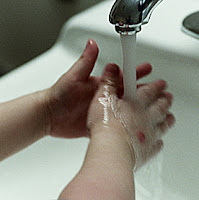 When I first heard this, I'll admit, I also thought not LETTING children wash their hands before eating was ridiculous, but when you think about it, as Dan Moulthrop (the show's host) pointed out, it kind of makes sense.
For the sake of simplicity, imagine a school which is made up of a single thirty student class of first graders. Now let's say it's lunch time, should the teacher release all thirty students at once to the bathroom? Talk about a bad idea. Of course this problem is pretty simple, this small class could easily be released in groups of five, no more than three boys or girls at one time. It would take a bit of time to manage, but not really a big deal.
Only there's no such thing as a school made up of just first graders, and even a thirty student classroom is pretty optimistic these days. What happens when two or three classes have lunch at the same time? What if the entire school eats at once? Again, these single problems are easily solved by staggering times, but as the variables increase the solutions get a bit stickier, and the end result is a logistical nightmare. The more children you have roaming free the easier it is to lose track of a child (or ten), and this is generally frowned upon at schools.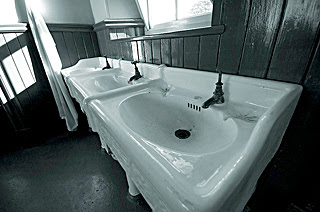 One possibility is to have the teacher escort the class, but then again you have a bathroom full of children all at once, disaster waiting to happen since the teacher can obviously not supervise both the Girls and the Boys room. If the teacher has an aide or two this might be easier, but with faculty-student ratios shrinking (spreading? I'm never sure which way that goes. worse anyway) all the time aides are probably a bit of a fantasy at this point, and even if they all do have aides, again you run into the problem of space, when an entire school has to eat at some point near midday.
The best solution Matt and I could think of was to have a bank of sinks at the back of the classroom. That way students can line up while the teacher supervises, and hopefully the mess and excitement that would otherwise occur could be avoided. Even this is not perfect however, since at a guess twenty minutes would need to be set aside just for hand washing, and unless classrooms are already equipped with a convenient bank of sinks, the likelihood of getting the funding for it is far-fetched at best. It's an interesting problem, and unfortunately I doubt the schools will come up with a practical solution. I don't say this because I think a practical solution doesn't exist, I say it because I don't trust any large institution (public schools) to both see and choose a practical solution.
*Photos from flickr and UK's Daily Mail.
Thursday, November 15, 2007
Asthma Devices
For some reason I was thinking of my asthma today. I was diagnosed when I was about eight and I was struck today with the sudden memory of the thing they gave me to control it.
Adult inhalers are pretty simple, and easily recognizable. Looking back I think at eight I probably would have been fine, but my pediatrician was a bit senile in those days and couldn't keep track of what sex I was (I had short hair) much less how old I was (I was also small for my age). So he gave me the kiddie model of inhaler which was a rather silly contraption. Please forgive my drawing, I haven't had quite the standard in industrial design training (I think they spend three hours a day practicing drawing circles) which is entirely my own fault, but there you go. The inhalers were medical blue, you know the color, and in three parts. The actual medicine came just the same as it does today, in it's disposable plastic inhaler. You would take the metal piece out and install it into the plastic mouthpiece, which installed into a spacer. (I haven't drawn the locking mechanism so you'll have to take my word for it). As best I can remember, the medicine actually went through the mouthpiece so I'm not exactly sure how it went into the spacer rather than into my mouth. I think there was a grey rubber thing inside with an "x" cut through it so the air inside would only come when the child using it sucked on the mouth piece. The spacer itself was sort of a cross between a balloon and a trash can. It spiraled together to collapse on itself, then unwound into a blue cylinder. It made a noise that my friends claimed sounded like Darth Vader, but didn't really. It was a surprisingly loud plastic sound though.


*Basketball picture from flickr. Children with inhalers from here and here.
Thursday, November 08, 2007
Swordfish
No, I'm not talking about the world's most obvious password. I'm talking about the fencers over at Hooked on Fencing (HOF), or more accurately, I'd like to speak about the space they fence in. HOF has the largest (and nicest) fencing facility in Northeast Ohio, which is pretty impressive considering it's non-profit and most of the members are teenagers.
 I've been fencing with HOF sporadically for three years or so. When I first met them, they were fencing out of a church gymnasium (which is more common that you might think for a fencing club) which wasn't really ideal for anyone. They had to carry all the electric equipment around which means they were only ever able to set up maybe three strips (this is kind of like the court where two fencers spar) at one time. Often times they were fencing around cafeteria tables which at least made it easy to find a place to set your bag.
Near the end of 2005, HOF signed the lease for a space of its own. It was a good sized space, a warehouse, and a huge improvement on the church. The downside of the space was the concrete floors, which are brutal to fence on: painful for older fencers (and by older I mean anyone over the age of 18) and harmful in the long term to younger fencers who are still growing. Mostly it's bad on the knees, but it's not really good for the feet, ankles and back either. This changed this summer, when the club teamed up to build a new floor out of plywood. I'm not sure who lead the effort, but it's well built (meaning I don't feel like I'm going to fall through) and a huge improvement. In addition parents of fencers have been volunteering for more minor renovations since the new place opened. Early on someone realized that while the utilitarian men's room would be just fine for the guys, girls are a little pickier. So they painted it a bright color, hung up a couple posters and put some fancy soap on the sink.  It's amazing what a difference it made, the room actually looks cute, inviting and modern. I realize I'm making a big deal out of a bathroom, but in any sport, which is typically dominated by men, it's nice that they made the extra effort to welcome women. More paint jobs prettied up the waiting area and changing room with some nice artwork on the walls. One of the bigger changes they made was in opening up the waiting room so parents had a nicer place to sit, where they can still watch their kids fence.
And Walt (the guy who runs the club) says sometime next year they're aiming to get aluminum strips installed. If you are not a fencer you need to understand that metal, grounded strips are sort of the ultimate goal for a fencing club, ESPECIALLY an epee club (which HOF is). Having grounded strips means that when a fencer accidentally hits the floor, the light (which indicates a point scored) will not go off so there is no (or less) confusion over whether a touch was scored. That's KEY, and to me it's the number 1 difference between a fencing space and a space where people happen to fence. They've already made several points in that direction. They have overhead reels (this is what a fencer plugs their weapon into for electric scoring) as opposed to floor reels. I don't find floor reels that much of an annoyance but a hanging cord system is sort of a mark of a professional salle (that's what the French call a fencing gym). More importantly they have a good number of strips, I wanna say ten but I'm not sure. The fencing gym at Notre Dame had fourteen, and that's one of the top college fencing programs. The floor is painted grey, which looks surprisingly cool on the particle board, with strips outlined in blue.
The only downside is that in spite of lovingly hung artwork, the place still looks like a warehouse. I'm not complaining, It's by far the best place to fence in Northeast Ohio, but I'd like to take this opportunity to describe my dream fencing salle.
The main room is 75 feet by 200 feet. One entire wall is a mirror. Think a dance studio, only four times bigger. The ceilings are insanely high, which is perfect for the loft that houses a sitting area for guests and spectators. Over sized lights and score boards are hung at the center of each strip with a number attached so that watchers can easily keep track of the score of their favorite fencer.  Two more pairs of normal sized lights hang at each end of the strip. The walls are painted a calm medium toned color with framed fencing art placed periodically with The Wall (an evil footwork pattern) painted artistically directly on the wall in several places.
Under the loft there is a snack bar with healthy snacks, and maybe a smoothie store (I'm dreaming here, remember?). In fact, the smoothie store serves meals as well, so fencers that didn't have time to eat can make up the difference. No food or non-water, non-Gatorade drink in the salle please. There are no benches or seats (or at least only uncomfortable ones), because fencers don't sit, they fence! There is however plenty of storage space tucked into the walls for fencing bags and water bottles. There are five rooms that split off from the main fencing gym. One is a large room with two elevated strips and bleachers around the edges. Two rooms are mens' and womens' bathroom/changing/shower rooms. The last room is an exersize room with aerobic equipment, light weights, and an open area for various exersizes; a book of suggestions for those and general fencing games will be included in the room. The last room has four strips, not set up for electric fencing. This is used for lessons.
Maybe one more room, while I'm thinking about it. This is a comfortable room, closed off from the rest with desks, tables and couches, where fencers that arrive early can drink their smoothie and do some homework or socialize with other early comers. Because of course, my ideal salle is open from 10am-10pm everyday. Hey, I can dream.
Wednesday, November 07, 2007
$100 Laptop (for just $190)


Today they finally started production, with their first set retailing at $188 a piece. Their first order is from Uruguay for 100,000 laptops. According to their website, as of November 3rd Ethiopia had recommitted to an order of 50,000 (though they've not yet ordered) and many other countries are interested, though not yet willing to commit. If they get enough orders Negroponte believes that the $100 would still be obtainable.
Monday, November 05, 2007
Ikealand
 Yesterday Matt, Amy and I drove up to Pittsburgh to get a few things from Ikea. This was only my second time going to Ikea, which means it was really only the first time I was able to process the experience.
 Ikea is so huge, so packed with so many different things that the first time you visit all you can walk away with is a vague sense of the scale. For anyone who is not familiar with Ikea, it's a Swedish furniture company that specializes in modern styles for cramped spaces. Of course the American stores have been adapted to US customers: Real Americans like their houses big. Real Americans also like to own a lot of stuff however, so Ikea's organizational solutions are still welcome and relevant to a US market.
As far as I know, Ikea started out in the US mainly targeting college students. It makes sense: the furniture has simple lines, very Euro, and more importantly it's relatively cheap, but still good quality. The small-space conscious design also helped in the college crowd, a huge bonus in the dorm rooms. These days however, the group of people who first fell in love with Ikea are in their late twenties and early thirties: moving from small dorm rooms to small apartments or small houses and trying to start families. Ikea's adapted beautifully, with upscale looking furniture alongside the stark utilitarian, and a huge section devoted to kids and babies.
 The charm of Ikea is that it's so smart. Scattered throughout the store are stations with foldable maps, large yellow bags to lug small items and, best of all, paper rulers to make sure that dresser will fit in the wall space you have in mind. Rather than making you drag larger pieces of furniture all over the store, they give you a chart and a pencil so you can write down the code and pick it up from the warehouse before you leave.
The design itself is also smart: while the store has a Ikea-unique style, the individual pieces are easy to blend into other feelings if Ikea-style is not your style. After even a first visit you'll start to realize that nearly everything in those "organize your life" and "quick storage solutions" is stolen from Ikea (although lately it's more like they're stolen from each other).  Even in design magazines not dedicated to organization you'll start to notice that Ikea furniture is turning up everywhere, though for some reason they don't bother to tell you that this is where you can pick up the chair or shelving unit of interest.
The cost of furniture in Ikea is kept low partially because everything in the store requires assembly. Personally I find it satisfying to assemble my own furniture, though I realize this may be a drawback for some people. Ikea assembly is a striking contrast to crappy target/walmart bookshelves or cube units, both because it goes together so much more easily, and because the quality is so obviously higher. About half the furniture in Ikea is made of gasp actual wood, and the units that are made from plywood are so cleverly veneered that it's nearly impossible to tell. The furniture is satisfyingly heavy and doesn't shake once it's put together, a refreshing change that makes construction all the more fulfilling.
Ikea intelligence is evident in constantly evolving solutions. My favorite piece from yesterday was a TV stand with a gap in the back for wires.  I realize this doesn't sound all that innovative, but the table is also beautiful, they managed to make the wire gap a part of the design so that you might like to use the table even if you didn't need a way to hide your wires. Most tables I've seen that give access to outlets are ugly or try to hide it in back. Instead, Ikea does the smart thing and incorporates it into the lines of the table.
Another solution I enjoyed was a slotted headboard designed to allow shelves and other helpful hangers on to clip on. It's attractive enough that it would fit in any bedroom without looking ugly, the kind of ugly you sometimes get from furniture that is far too functional (think of wall to ceiling built in shelving in a bedroom). I think this would be best though for a teen, or even a preteen. Here's yet another: you know how when you wash a mug in the dishwasher it gets that shallow pool of nasty water trapped inside the bottom lip? Ikea built in dips, making the bottom of your coffee cup look kind of like a castle tower, that allow the water to spill off so you don't have to deal with it.
Then there's the cafe/restaurant, brightly lit with a funky, extremely Ikea lamp hanging over each table. The food is much better than you'd expect from the cafeteria style in which it's presented, and they provide cute plastic kids' utensils right next to the normal silverware. They were so cool looking that Matt and I each used the kiddy knives instead of real knives and I was actually a bit disappointed that they didn't serve my food on one of the brightly colored rectangular plates. To further accommodate families they actually have a "stroller parking" section just outside the cafe in a design that is both functional and really cool looking.
 Even the packaging at Ikea exudes brilliance. I'm sure I'm not the only one who's gone to the drugstore for allergy medicine, bought a giant box, opened the box to find that three quarters of it is closed off with card-stock paper. The last quarter contains a three inch tall pill bottle which is stuffed with cotton and at the bottom you find twelve to sixteen tiny pills rattling around, taking up only two percent of the bottle's volume. Over packaging is out of control but Ikea not only doesn't over package; their disassembled pieces are packed up nice and tight with just a thin layer of foam to keep it scratch-free; when reasonable they'll change the shape of the packaging to better accommodate its contents. I saw some tetris shaped boxes containing table lamps that did not just better fit (and therefore protected) the lamps, they also locked snuggly together to protect themselves during shipping.
I guess I'm overwhelmed again by Ikea, but this time with hero worship.  If there's one thing I love it's intelligent design (not the kind they have in schools in the South mind you) and Ikea is constantly making me smile. A few weeks ago I stumbled on a website called Ikea Hacker which takes it a step further. Ikea furniture tends to be so modular that it's easily changed into other things entirely, and people from all over can exchange ideas to come up with insanely creative concoctions. One piece I especially liked isn't all that innovative, but it's just so freaking cool that I can't wait to do it in my house of the future. It's just a set of shelves that has that perfect balance of clean modern lines and industrial cool that I love so much. I'm wondering how long it will be before I'm contributing to this site myself.

Thursday, November 01, 2007
Trick Or Treat?
I've seen a lot of blogs lately about what's "ok" for kids to do on Halloween. There's quite a lot of talk about taking a child's candy as soon as they've gone trick-or-treating, to prevent them from gorging themselves sick on chocolate. Or of "trading" candy for toy bribes, or sometimes just throwing the loot away.
Now I understand what parents are afraid of, rotting teeth, obesity, sugar crazed brats. But for crying out loud it's HALLOWEEN. These precautions might make sense if you have a kid with allergies, or even a kid who's too little to understand trick-or-treating in the first place, otherwise it's just cruel. Way to ruin the fun. Nothing's wrong with a little gorging, the kid will gain a pound, make himself sick, and be unable to eat anything the day after anyhow, balancing the whole sugar gain. Or maybe not, but at any rate it balances in the end and one day of celebration isn't going to make a lifetime habit of overindulgence.
Then there's the question of "trick." I've read a ton of comments about those damned vandals, throwing eggs which create permanent property damage, and other sorts of Halloween tricks that bring no end of nuisance and hurt feelings. The question of whether it should be allowed is sort of irrelevant, more important is why it's happening in the first place.
When I was a kid, the charm of Halloween had nothing to do with tricks, or even really the treats. It was all about the feeling in the air. There was a feeling that anything could happen, ghosts could come up behind you, you could discover an ability for magic, maybe meet a vampire. And all that mystery was all the more delicious because I was young enough to feel secure, safe, automatically protected. I was ready to witness these things because I knew I'd survive them, any other consequences just added to the sense of yummy danger. The idea that someone out there was up to mischief made it all the more fascinating, but I myself never had the temptation to throw eggs or toilet paper, or smash pumpkins on the street.
Why didn't I have the temptation? Because I continued trick-or-treating until I was fifteen or sixteen, in other words, far too old. To my mind, that's the real trick: teenagers. I could (but won't at this time) talk for pages about the problem of teenagers in general, a created class of people that is neither here nor there, and utterly confused because of it. Instead I'd like to talk about this chunk of people on Halloween.
When a five or six year old says: trick or treat? he probably doesn't realize what he's saying. Even as we get older we don't really consider that phrase a negotiation, and consciously it's not. On the other hand when a sixteen-year-old comes to your door with a plastic pumpkin and says "trick-or-treat" most people will give them the: "aren't you too old for this" glare, and in a way, it's these skeptical neighbors that are pushing the trick-or-treat towards the "trick" half. I was encouraged to stop trick-or-treating when I was about twelve, not that I did. You don't even have to tell them they're too old, a child realizes this the first time he or she is asked, "are you going trick-or-treating this year?" as though it were an option, as though the possibility not to go actually exists. We expect these kids to grow up in the course of a year, but they still want to dress in costumes, want to be a part of Halloween magic like they always have been. So when we tell them they're too old, and provide them no other way to be a part, they find their own way. Somehow we are still surprised to when our trees are covered in soggy toilet paper, or the paint job on our cars are ruined by eggs.
I'm not saying vandalism is ok, but aren't we kind of asking for it when we, as a society, tell kids we aren't going to give them the "treat" any longer? Personally, when I have kids, and they start to indicate a reluctance to go trick-or-treating, I'm going to buy them a whole bundle of TP. If they're going to go out playing tricks, I'd rather it be the huge nuisance kind than the permanent property damage kind.
Sunday, November 26, 2006
Borders Spree
Well I think it's been a while since I last spent much money on books, but I got a super borders shopping day (or something) in November, so I must have gone through more than I remember. I did buy Fledgling by Octavia Butler, a copy of the constitution and I feel like something else I can't remember a while ago, but it seems like longer than October. At any rate, I've got another supershopper day now because I dropped about 70 bucks on books this week. Hey, if you've got to have a habit, there are worse ones to have than books... right? Right?
It's not entirely my fault... at least that's what I'm claiming. There were a couple of books that I've been waiting FOREVER for the paperback version to come out... and they did. I picked up George R. R. Martin's A Feast For Crows and Gregory McGuire's Son of a Witch. Then I continued to wander for a while in the sci-fi fantasy section... now normally I have some measure of discipline in Borders these days because I really don't have much cash to spare... but...
I mean Neil Gaiman. I HAVE to buy anything that's written by him, it's like a rule. So he's got a newish short story collection, Fragile Things, and I didn't even hesitate to pick up the hardback because, well because it's Neil Gaiman.
Then I wandered over to the children's section, my true weakness. I LOVE children's books and I have several authors that I immediately buy anything new I see of their work. The list includes: Diana Wynne Jones, first and foremost, my favorite children's author and possibly my favorite author period; William Sleator, not everything he's written has been amazing or even really good, but he's had a few grand slams like The House of Stairs that make me give anything he writes a try; Monica Hughes, she's been dead since 2003 and most of her work is out of print, but I love everything I've read by her; Tamora Pierce, I've been reading her work since I was eleven I think; Patricia C. Wrede, though mostly I'm just trying to fill in my collection there, and Bruce Coville for nostalgia value and sheer entertainment, though the age group he writes for is a little younger than what I usually read. So the first thing I saw was a book new book by Tamora Pierce called Terrier: Beka Cooper #1. Obviously I had to pick that up as well.
I read that one first, it was pretty good but not her best I think. Trickster's Choice and Trickster's Queen are my favorites, but I guess that's because Aly (Alanna's daughter) is my favorite of Tamora Pierce's main characters. You have to give her credit, she is fantastic at writing strong female protagonists, and Terrier certainly continues that tradition. I like Beka, she's bright and has enough faults to be sympathetic rather than larger than life. Beka doesn't exactly have a speech impediment, but she's so terrified of public speaking she may as well have. She's also just a bit overeager, but that goes away quickly, so I hope her speech problem won't clear up to easily... Beka as a character has a great deal of potential to either become far to perfect or to become Pierce's strongest (deepest) character yet. I think Beka's strength is that she's very nearly ordinary... her most striking or helpful attribute is determination. She does have magic... or the gift as Pierce calls it in Tortall, but it is I think a relatively small gift compared to say Alanna. Her gift is more like George's (appropriately) useful (and painful in Beka's case) but small and unremarkable. True, Beka excels as a trainee cop but with the explanation of her background that's not too difficult to believe. My hope is that she stays in the believable, of course I want to see her succeed, but I'd like her to stay as real a person as possible. So far, Pierce's characters are all a bit TOO strong for their own good. Alanna's only fault is crankiness: She has a huge "gift" and fighting ability so amazing that she becomes a legend before she becomes a knight. Fine, great, the Lioness Quartet is the first series I read by Tamora Pierce (and I think the only ones that existed when I was that age) and they're wonderful. It's a fantastic series teenage and pre-teen girls, and I wouldn't want Alanna to be any different, or less, than she is. Then comes, in some order, the Circle series(es) the Immortals series, Protector of the Small, and the two books in the Trickster series (which I hope will be followed by at least two more...). The Circle books are great fun, they give glances at child-mages at different stages of growth (currently into young adulthood). But all four mages are child prodigies, they harness more power than any of the well known and snobby mages they encounter will believe until they are forced to show them. Again, I wouldn't want it any other way, but it does cause a certain amount of predictability and somewhat shallow characters. Good characters though, Daja especially, though Briar's my favorite. The gay themes are subtle and nicely done as well. The Immortals series is probably my least favorite, I'm not sure why. I think that's just a matter of personal taste rather than a comment on the writing though, but in the continuing trend of ridiculously large characters, Daine is not only the strongest and best mage of her type... she's the only one. Nobody can teach her really, because there are no other ani-mages who change form like she does... it's cute, but a bit much for me. The love interest between her and her teacher is interesting though, and although it's very obvious and easy (once it's accepted) I've got to give her credit for making things complicated situationally. The Protector of the Small series is, I think, her strongest writing to date. Kel is a wonderful character, quiet and even tempered. The situations that she finds herself in are a bit over the top, but then, it wouldn't be an interesting story if they weren't. The issues raised about gender roles and relations are important, if a bit heavy handed, and Kel's love life is the most realistic romance Pierce has written. But although Kel has no "gift" she is in her way a bit too much as well, she's a giant physically, and she's by far the strongest student in nearly every field she tries as page, squire and night. Then there's Aly, in the Trickster books. She's so much fun, but she's just SO clever and even her mistakes work out for the best.
So I want an ordinary character. Leave Beka alone please and let her blunder through her duty like the rest of us do. Please Tamora Pierce, give me a story about a girl who's just an average kid, because it's great that you want to prove that women are just as strong as men... but do they ALWAYS have to be stronger? And when you're done writing about ordinary Beka Cooper, I'd like a story about the next female Tortall page, who's not excellent, who isn't helped along by magic, or strange foreign upbringing, or a mysterious benefactor, but who manages, painfully, to make her way to knighthood anyhow. She can be smart, and strong and stubborn and creative, she'd have to be I think, but does she have to be superhuman?


