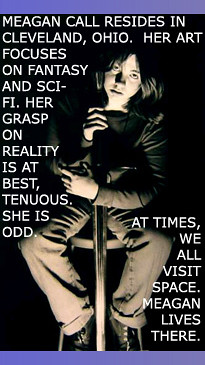
Update: New blog: A Certain Lack of Focus is up and running! See above for most recent updates.
Ok, you may have noticed over the last few weeks that my blog has been moving around a lot. The problem is that I've recently decided that, as much as I enjoy the ease of use in blogger, I want a bit more freedom when it comes to design. I temporarily moved hosting over to my website, but if anything this puts more restrictions on design, so I finally decided that it's time to move to blogging software. I'm still fiddling around with what kind, because at this point, I really know nothing about it.
The challenge has been trying to figure out how to use new software without losing the content of this blog, and I'm still not entirely sure whether it's possible. At this point, I think it's not worth it, and so instead, I'm putting Living in Space on permanent hiatus.
I'll be starting up my new blog at www.hadesarrow/blog just as soon as I can figure out how to work the software. I'll keep you posted once it's officially "launched" but to be sure you catch me, please change your bookmarks to www.hadesarrow/blog. Thank you!
Thursday, November 13, 2008
New Blog


Friday, August 29, 2008
Micro Memory
 At Aunt Sharron's, the summer I turned five, my cousins found some baby mice. I thought at first they were toy plastic pigs, because mice are born without hair. We showed Aunt Sharron, we thought they were sweet and I hoped to keep them for pets. Instead, she threw all the babies- far younger than me- over the fence like the garden snails. I knew without asking that this was not to send them along to live somewhere else, but to splatter their little pink bodies on the hot sidewalk.
Wednesday, May 28, 2008
200!
I just reached page 200 in my novel! I think I'm finally getting close to being finished. Right now I'm working on the climactic scene, which is more because I'm skipping around than because I'm actually that near the end. I expect the finished book will be about 250, maybe a little longer. There are a few scenes I'm putting off writing, either because they're difficult for me (the beginning is giving me fits) or because they're such a big deal I'm still intimidated by them. As I close in on them it will get easier, at least that's how it's been working so far.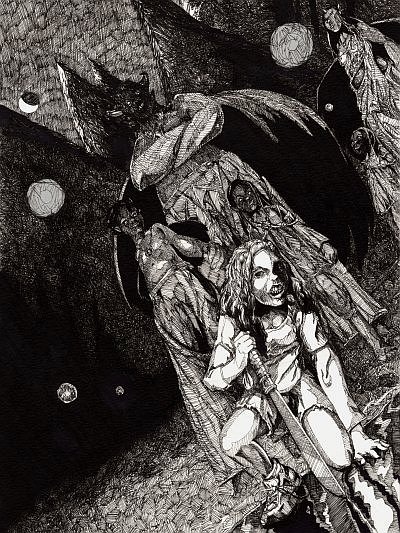 Writing a novel is a new experience. I chose to do a novel for my MFA thesis because I was afraid that if I didn't write one now I'd never write one. This particular story has been forming in my head for about seven years. I was feeling depressed, chatting with my friend Adam and trying to explain the kind of isolation I was experiencing. Finally I told him, "it's like being a changeling," and from there the story exploded.
It's pretty much unrecognizable now from the comic book concept I came up with as an undergrad. Gale is the main character of this book, part 1 of 4, and she didn't even exist in the initial conception. When I did invent her, I intended her to be a "bad guy" a nemesis for my main character, but instead she's turned into a full and tragic character, in some ways even more engaging than my initial protagonist, Breeze. Breeze will take over in book two.
One of the most alarming things about novel writing is how unpredictable it is. I'm used to short stories, 14-17 pages long, where I usually know everything that happens before I write it. With this novel, Lost Child of Summer, I had a vague outline in my head, but while the start and finished stayed at roughly the same spot, the middle wiggled around like the body of a snake. I know it sounds cliche, but it's almost magic to see how the characters take on a life of their own and the story twists in unexpected ways. It makes me feel a little powerless to realize that I'm not actually in control of my own story. With about a fifth of the book to go, I'm still not entirely certain about what's going to happen in certain parts. How weird.
Anyway, getting closer. Wish me luck. Here are some sketches I did way back when I first came up with the story. They don't really fit any more. Click on the images for a large version.
Page 1: "In more superstitious times it was believed that a spirit might come and steal an unguarded child." "The child would be replaced with the spirit's own unnatural babe. Candels, bells and other charms were often used to protect against this." "But sometimes the charms failed..." "And a human baby was lost." "And sometimes..." "No one noticed."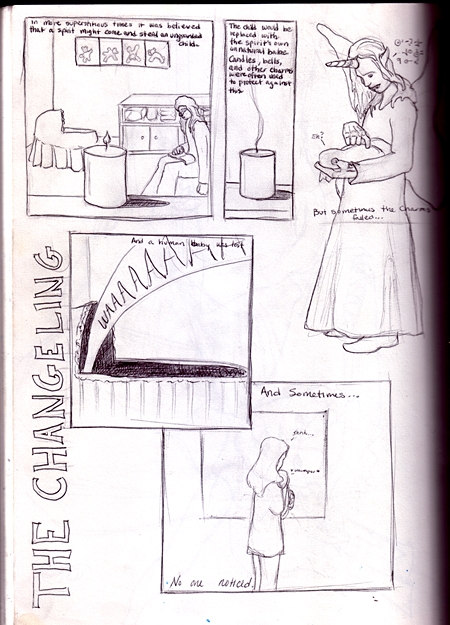 Page 2: "Naptime age 1 1/2" "2nd birthday party" "Zoo visit age 3 1/2" "Family Camping Trip, age 5" "Basketball game 1st grade"
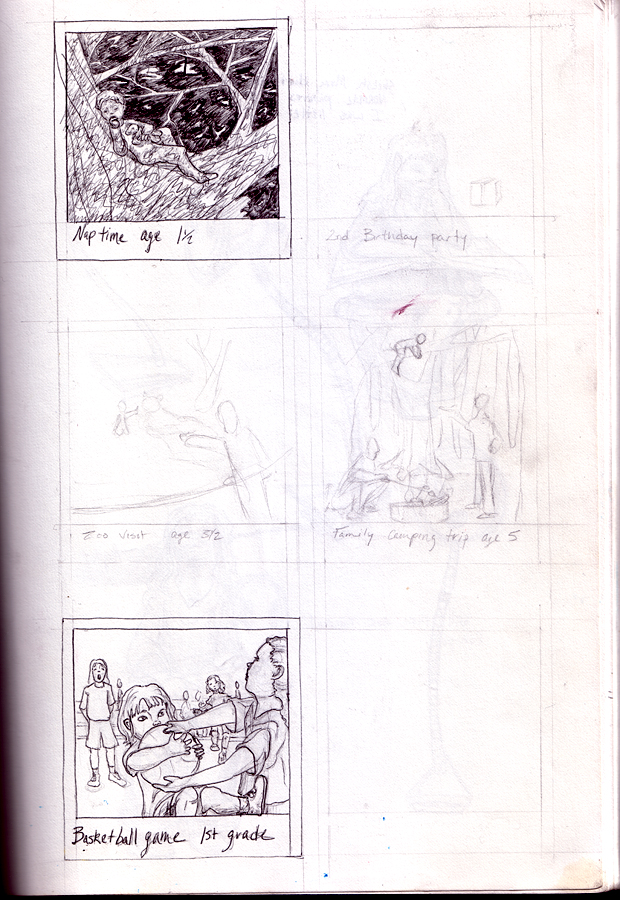 Page 3: "Sheesh Mom, don't you have any normal pictures of me when I was little?" "Well... those are normal. For you." "Right."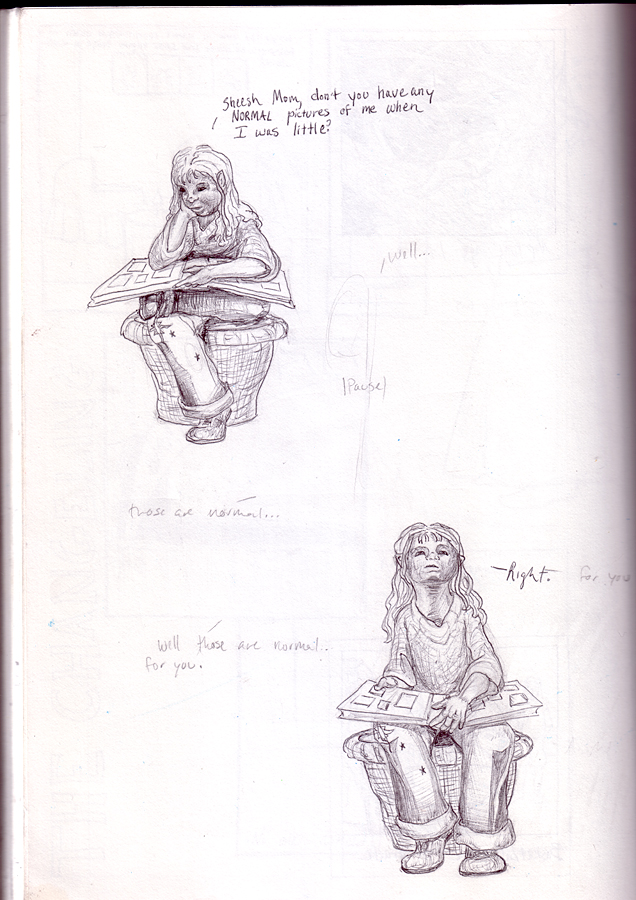
Friday, May 09, 2008
Long Last
I am OFFICIALLY done with ALL my classes. Ok, maybe not officially until the grade comes in, but I don't have to go to any more classes! I am exactly 1 credit short of my M.F.A. *happy dance* Which doesn't actually translate to the amount of work I've got left... about another third of a book, 50 plus pages. *slightly slower happy dance*
Monday, March 31, 2008
Fantasy and Spreadsheets
Yeah, who knew I could put those things together in a title? So I've spent the last two hours plugging ages of faeries for my novel into a spreadsheet to see how things break down. It's been shockingly helpful. There are a couple of tricks with my faeries that make figuring out character age difficult. The first trick is that the faeries age at about human speed during childhood, then at around age 11 when they begin puberty their aging slows dramatically. At around age 13 they "change" getting their wings, horns, lengthened fangs and become sexually mature (sort of... about as sexually mature as you would expect a girl who just got her period to be: aka able to reproduce but not necessarily recommended).
The other trick is that this group of faeries lost a war about 18 years back. When they lost, the victorious faeries slaughtered all the elders (faeries over age 70) and all the faeries of reproductive age (13-63). When the leader of the tribe begged, they left some children alive, but killed all the children that were descendants of the remaining faeries (there's a practical social reason for this which I may explain later). So what had previously been a healthy population of faeries (ok I know that sounds ridiculous, but bear with me) was left at 25-30 older faeries and five children aged from under a year to eleven years. It took five years before the oldest of these (a female) was able to reproduce. The next oldest female (in terms of reproduction the adult males are still viable, so male children are irrelevant) was only five years old at the time of the war, which means she would not be able to reproduce for approximately eight years.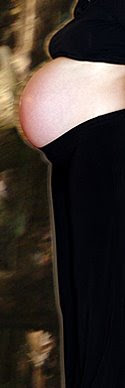 This all sounds a bit cold, and it is, but by playing with these numbers I've discovered some interesting things about the society I'm creating. For one thing, I've got all sorts of extra reasons for the frustration and bitterness I've already put in there. That's nice to know. The main thing I've realized though is that for the female children left after the war, life would have been hell once they reached reproductive age. The oldest child for example, had five children in the course of thirteen years, all by very old men (faeries). The oldest of these children was taken from her, the next oldest lived, the next was mutilated, the next was stillborn and the last lived. At the time the book takes place, she's pregnant again. Possibly even more devastating than her status as a broodmare is the fact that she would have been forced into sex pretty continually as soon as she matured until it was evident that she was pregnant and then again once the babies were born. This is not only because of the brutal nature of the characters in question but the practical concerns of rebuilding a population that was growing from 300 or so pre-war, and shrunk to 25 immediately after.
She's not a particularly important character but knowing this makes her more important to me. It gives me a better understanding of my creatures and my story. I also now realize that whatever desperate measures this group of faeries take, they are probably doomed in the long run since they have only three blood lines to start from. Suddenly, just by putting something as simple as ages into a spreadsheet, I know all sorts of things about the society I created that I never would have imagined on my own. Now that's weird science.
*Pregnant image is an altered image from a photo I found on flickr. Linked.
Wednesday, March 26, 2008
Online Graphic Novels
I'm currently reading How to Make Webcomics
 Something that I found interesting in this book is that rather than referring to serial web comics as online graphic novels, the authors call them longform comics. I'd never heard this before, but it makes sense and I really appreciate the distinction.
What's the difference you ask? Well, there may not actually BE a difference, but in my mind there should be. I love longer story arcs like you get in graphic novels but I don't think the traditional graphic novel form works on the web.
Take MegaTokyo, a popular webcomic (maybe not a great example since it's obviously succeeding, but bear with me) drawn by Fred Gallagher. This is done in a fairly traditional graphic novel style, in fact I think they're on something like book 7 by now. But while the art is engaging and sometimes amazing, I could care less about the story. Now that may just be me, I don't particularly care what dumb thing Piro did this time to piss off his girlfriend or the girl he wants to be his girlfriend. Some people like this style of comic story (there's a huge genre inside manga that does this exclusively and MegaTokyo is kind of manga) but it's just not for me. I think though that the larger reason it fails (by my standards) is that graphic novels move so SLOWLY. Think about it. I've seen graphic novels (and MegaTokyo is one of them) that can take ten pages before anything happens. I've seen MegaTokyo posts where an entire page is just one of the characters looking sad from various angles. This works great if you're pacing a graphic novel and you have the entire book in front of you to read at once but... MegaTokyo posts three times a week! That means you could be waiting more than three weeks for something, anything, to happen. It's just TOO slow.
Now I haven't seen many other serial type webcomics, but I'm wondering if there's a way to have some balance. Can it be fueled by a larger plot, with important developments happing slowly along the way, and still leave the reader with something satisfying on a page by page basis? I think it can. I'm working on starting a webcomic now, egged on by reading this book, and that's what I hope to accomplish (I'll keep you posted).
As for MegaTokyo, it's obviously doing just fine. It has a ton of dedicated readers. I don't know what motivates them, what keeps them interested. Personally I still visit the MegaTokyo site when bloglines tells me there's a new strip, but like a high school kid with a Playboy, I'm just looking at the pretty pictures.
Tuesday, March 18, 2008
Another Landmark
 Today I hit page number 150 on my novel/thesis. Only about 120 pages are consecutive, and alot of the rest is page breaks and single line notes, but hey, I'm taking reassurance where I can find it. That's 51,459 words. I might actually be able to finish this! Granted that's book one of four, and getting it written is probably nothing compared to finding a publisher, but quiet you, I'm gloating to myself.
Writing in the Family
I haven't been following Neil Gaiman's blog for super long, but I'm RSSing it now (not actually a word, but whatever, one of my favorite professors claims anything can be a verb. Thanks Bob Pope!) and today read the MOST adorable post ever. Apparently his thirteen-year-old daughter Maddy occasionally blogs on his blog. He doesn't have separate pages for posts so I can't link directly, but go to his blog and look for the post called "picture time" on March 18th. So sweet and a little odd to hear my favorite grown-up author being described as a dad. Even if you're not a huge Gaiman fan, it's worth checking out.
Friday, February 01, 2008
Living Online
 I was reading Neil Gaiman's online journal and it got me thinking about modern authors and whether or not they really take advantage of the internet.
It seems like well known authors fit into one of three categories. The first is full throttle web presence: Gaiman fits into this category. You can find out anything you might want to know from his website, and (nearly) daily he updates his journal with thoughts that are interesting enough to keep people coming back. Obviously to me this sounds like the best option but I can understand why not all authors would opt for it, or why they might do it with less than full enthusiasm. Stephen King has a frequently updated site like Gaiman's, but it's clear he doesn't put quite the same attentiveness into it. Although there are still nearly daily updates, they are brief and seem to be done for the sake of doing it: it's a message board rather than a blog. Only the occasional update comes from King himself which is an important difference. Still, there is a current and full web presence for Stephen King in a similar way as there is for Neil Gaiman. J.K. Rowling also has a site like this, though she doesn't seem to update the blog section as frequently. This site, I might add is one of those obnoxious visual ones that looks super cool but is a pain in the ass to use. One of my favorite artists, John Van Fleet is guilty of the same sin.
I would classify the second segment as authors with helpful, current official websites, but without the author's presence. Terry Pratchett has a website like this. It's attractive, informative but not particularly personalized. I'd wager Pratchett has never actually spent much time on his own site and didn't put much input into its design or... anything really. And that's completely fine. At least you know that whatever's on there is going to be accurate. Then there's the third type which is the one I really just don't get. This is the category of authors who not only have put no work into their online presence, they haven't bothered to pay someone else to do so either. My favorite author is children's author Diana Wynne Jones. When you click on what google calls her official website, what you get is actually an extensive fansite. The information on there is likely current, and probably accurate, but who knows really? The design is horrible, which is understandable because it's by fans, and probably something put together in some teenager's spare time.
In all fairness, I think Diana Wynne Jones is getting on the older side, so her lack of online involvement isn't entirely surprising. But then I come across the website for Tamora Pierce which is again, a badly designed fansite. I'm not sure how old Pierce is, but anyone who writes comic books is young enough to have a real website, not something put together by dedicated fans. Particularly for someone like Pierce whose primary audience is teenagers.
These authors are popular enough that web presence might not be necessary (though I can't think it would hurt) but in the future I see that changing rapidly. I'm always shocked when I look for an author or artist and discover that they don't have a website these days. Worse, a new business should always have a website, it's something relatively cheap and extremely easy that may help increase a customer base. Even my dad has his own website and he can't even copy/paste without help. I think the electronic age has taken over so quickly that some people still don't realize we're in it.
Wednesday, January 23, 2008
Dreaming of fiction
 Neil Gaiman is one of my favorite writers. I've read interviews with him and one of the things I find interesting is how much his writing philosophy differs from mine. Specifically how he looks at inspiration.
Someone asked him if he got inspiration from his dreams, and I was surprised that he said never. He claims that dreams are too fragmented, too anti-story to make a story out of.
I get what he's saying. I'll wake up from a dream and think: this would make the best story ever, and sometimes I'll write it down. Then I'll look at it later and think, huh? But even though it doesn't come in pre-packaged story format, dreams have provided me some of my best story ideas. And when I've already got a story going, I'll wake up in the middle of a particularly screwed up dream and suddenly have the missing element. What I wonder is if Gaiman is just reluctant to talk about dreams because inspiration is such a tricky subject.
Authors are always asked where they get their ideas. It's one of the most common questions because people think, if I could just get ideas like that, I could be there. But inspiration is hard for writers to talk about because I think mostly we don't KNOW where we get our ideas. They're just there and then we're turning them into stories. So authors make up bullshit answers or sidestep the question. I think I know the answer though, and it's that ideas come from freaking everywhere. The reason it's so hard to define the where is because there's no particular where, ideas are as common as air. The only difficult part of getting an idea is holding on to it. I think most people don't recognize good ideas. Or bad ideas for that matter. Any time you think "what if this..." that's an idea, but most people let the thought go before it can develop. I think that's where ideas come from. It's not the ideas that's difficult, it's the execution.
*Image linked to IMDB.
Tuesday, January 22, 2008
The power of words
I ran across an article on MSN the other day that I found interesting. It talked about how using different words in real estate ads effected the time it took for a house to sell and the final sale amount. I don't find it surprising that words can have an effect on these things, what I do find surprising is how much of an effect they can have. Just including the word "landscaping" for example, makes a house sell (statistically) 20% faster than other properties, and sell for 6% more. That's a pretty impressive difference.
 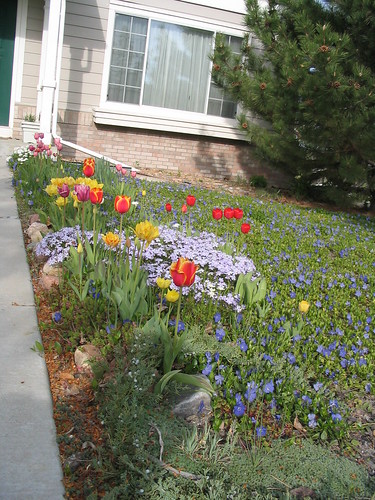 Of course, as the article points out, just adding in the word landscaping won't help at all if there's not actually any landscaping, but it's interesting that mentioning it can have such an impact.
Other words and phrases had negative effects or mixed effects. It shouldn't be too surprising that describing yourself as a "motivated" buyer is likely to drop the selling price by an average of 8%, but I was surprised to learn that it slowed the house sale by 30%. Defining a house as a good rental property, an income line, was even worse, slowing the sale by a whooping 60% and docking the price by 9%. Some terms, such as "handyman special" lowered the price but also sped the sale. When I look at real estate ads, I assume the description is bullshit. Subjective terms such as "beautiful" can't be called false advertising, so the only price in tacking it onto the ad is the paper's word count. I guess it shouldn't be surprising that positive words help a place sell (for more) while negative ideas (even dressed up in positive sounding jargon) hamper a sale. I'm just surprised that many people are buying it (the description, not the house). So what I've really learned in reading this article is that I've got a few years to figure out how to get my apartment style condo some "beautiful landscaping."
*picture's from flickr, linked.
Tuesday, January 01, 2008
100
 This is my 100th post, something that I find extremely fitting since I managed to hit 100 pages in my novel/thesis today. True, I had to cheat a little to get there, but the "filler" is legitimate chapter planning that will be expanded as I go, a normal part of my writing process. Without it I have a very real 95 pages of story and the page count at the bottom says 102, so standing by my claim of having finally reached 100 pages.
This has been a good year. Matt and I got engaged which, while I can't exactly list it as something I've accomplished, does make me very happy. I'm almost finished with classes towards my degree, this semester I'll be taking my last workshop and thesis credits. Next year I'll have a single thesis credit left to complete. On a related note, I also started a blog for the NEOMFA community. It's not exactly hopping with popularity, but we've got a handful of authors and I suspect we'll have many more join next semester. Last year in March, we adopted Tricky. She was pregnant with six kittens, all of which were born healthy and thrived, much to our exhaustion. To Chyna's dismay, we kept the kittens until June, when went to Scotland to see our friends Greyson and Amy (different Amy than I've mentioned before, that Amy was taking care of our cats) get married. Once we were back in town we moved to the condo, a smaller space than Matt's apartment, and started working on consolidating two spaces to one at the same time as introducing two angry, female, adult cats. Surprisingly, they're good friends now, though the space is still a mess.
This year marks the first time I've felt that I had some kind of skill set that might actually allow me to get a job. I've also lost 20 lbs which makes my doctor happy, and doesn't exactly get me down either. All in all I'm feeling pretty positive about things. I do live with the constant fear that I'm a bit too happy and something horrible is bound to happen, but here's hoping that gut clenching paranoia is a karmic payment?
Thursday, December 20, 2007
Shakespeare Horror
 I'm reading a literary satire at the moment called The Eyre Affair
The main character is meeting her ex-boyfriend for a night out at the theater. Here is the show they're planning to see: "No other play but Richard III
 So basically it's Rocky Horror Picture show... for Shakespeare. How freaking cool is that? Why don't we have something like this? I wonder how hard it would really be to produce it. Of course in our society it would actually be quite difficult because it would require a full house worth of audience that's dedicated enough to Shakespeare to memorize it, well enough to banter about it and improv. Not real likely I guess. Still it's a nice idea.
The show in the book ends with the Battle of Bosworth, with the majority of the audience participating. "...fortunately this time no one had been seriously injured during Bosworth." A pink toy horse was supplied in response to Richard's anguished cry of "My kingdom for a horse!" Really a fantastic idea, even if it's a bit far-fetched in application.
*Images are stolen and linked. You know the routine.
Tuesday, December 18, 2007
Adapting
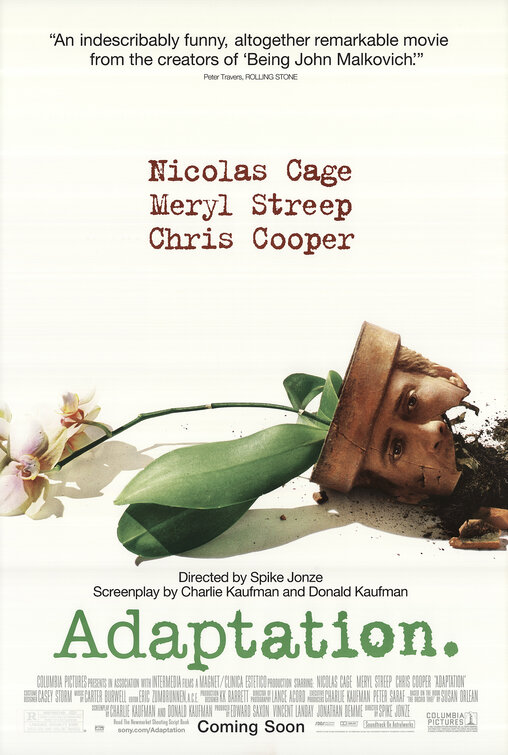 I realize this movie came out four years ago, but I just watched the movie Adaptation
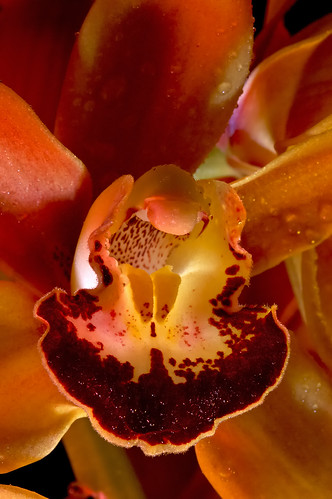
Honestly I think the reason I never watched it is that the third line of the back summary describes one of the characters as "obsessive orchid hunter," and I think, how can this possibly be interesting? I think I probably stopped there. I didn't bother to re-read it before Matt and I watched it the other night, so I didn't really have any expectations.
It is about orchids, somewhat, which weirded me out since my friend Kim posted a picture of an orchid yesterday. Mostly, although the film revolves around orchids, it's not about orchids at all.  So we've all heard of meta-fiction but I haven't really considered its applications in film. The closest I've seen is when a character addresses the audience, interrupting the movie and reminding everyone that they're watching one. This is uncommon and generally clumsy in film though it appears more frequently on stage. The theory I'd guess is if Shakespeare did it, it must be ok.
Adaptation goes much further than simply addressing the audience however (and never in fact directly addresses the audience). The screenplay, by Charlie Kaufman, is about the character Charlie Kaufman (played by Nicolas Cage) writing a screenplay adaptation. The adaptation is of a book called The Orchid Thief
 While most people call Kaufman's work surrealist, I'd also call this movie a beautiful example of meta-film. Cage, as Kaufman, is constantly struggling with writing the screenplay that we're watching. He decides to put in elements which we will, or have already witnessed, and ends the movie by telling us in a voice over that he'll end the movie with a voice over, ending as it ends.
There are some wonderful moments in the movie (warning: spoilers). Early in the movie a passage from the book talks about the fatal nature of orchid hunting, giving stories of orchid hunters who've died in their obsession. This sets us up beautifully for the deadly ending which would otherwise be overblown. Orlean (Streep), drugged out of her mind on orchid dust, says, flatly and with hilarious predictability, "We're going to have to kill him." Although the moment is obvious should seem overplayed, it's balanced by earlier comments by Kaufman about similar movie elements being predictable and overdone.
After watching this movie I'm not at all surprised that the same man wrote Being John Malkovich

 Orlean makes comments in her narrative about wanting nothing more than to want something, and this reflects Kaufman's struggle. Although he is not lacking desire, he's so terrified of acting on them that he's paralyzed inside his dark shell of a bedroom. This is a movie about isolation, about people who need to be released from their inhibitions to make any kind of human connection.
*Pictures are stolen and link to wherever I stole them from.
Monday, December 03, 2007
Making a Book
 This will not be a post about creating a lovely handmade gift with some decorative Japanese Stab binding and confetti rice paper. Not that I have a problem with hand made books or Japanese Stab binding (though I do find double-fan adhesive binding politically offensive) , I took a class called Artist's Book and Paper Making at Notre Dame lots of years ago and am actually much happier to have taken it now than I was at the time.
No, this post is about a project that one of my professors sprung on our fiction class this Saturday.
His idea is that since we are all ultimately working on having books published (or else what are we doing in an MFA program? Honestly?) We should start to put together a "book" from what we have so far. This entails getting a binder, arranging everything to it's best advantage (kind of a non-issue for me since I'm working on a novel), putting in title pages and acknowledgments, a table of contents, an about the author. Now this sounds a bit elementary school at first, but the more I think about it the more I'm getting into it. Dawson, one of my classmates, pointed out that it's both exciting and helpful to see your work in a form resembling a book, even if it is just a 3 ring binder.
  That also makes it easier to visualize as a book, in a bookstore, with someone, maybe even a few people(!) wanting to possibly read it! Hey, we all need a little extra motivation sometimes. In my case I'm also hoping to create some cover art for the book, not just to give it an authentic feel but because I've been playing around with some cover ideas and this will force me to sit down and actually craft some initial attempts.
So if my "Drawing of the Day"s this week are all thesis obsessed and with no explanation provided (don't want to spoil the story) please bear with me (all two of you that read my blog). I'm making a book.
Thursday, November 29, 2007
Hey look at me, I'm posting again!
 I met with my thesis adviser today. It was surprisingly good.
Sheila's wonderful, it helps that she actually likes my writing but she also has good advice (which I suppose is the whole point of being in grad school). I've been struggling like mad over the latest section in my novel so it was nice when I went in with it, half finished, and had Sheila tell me I should leave it as is. She thought the abrupt sections were intentional.
I'm fine with that, this section's been a pain in my ass, so if my adviser thinks it's finished enough I'm more than happy to move on. Meanwhile, I'm up to 94 pages. W00t. I'm hoping to hit 100 before the end of the semester (I've got two weeks, but I've also got a paper due in my nonfiction class), I think it's doable. Then I can ignore it over winter break and go back with a (theoretically) fresh mind next semester.
My hope is that I'll be entirely done by the end of Spring Semester so I can leave it alone during the summer (or just do structural revisions) and be a bit more clearheaded for revising next fall. The other reason why I can't really have much left to do in the fall is that I'm getting married in the middle of October, Honeymoon to follow, which could make cramming in much of a novel difficult.
Friday, November 16, 2007
Thesis Preoccupation
So far I'm about 80 pages into my novel, which I'm writing for my MFA Thesis. I've been making pretty quick progress but it's been stalled since I got back from DC. I'm not all that worried, but the fact that I'm not worried worries me (isn't circular thought wonderful?). The story is about seven years in the making. I won't tell you what exactly it's about because I wouldn't like to ruin the surprise. When someone asked yesterday I told her it was about faeries, adolescence or humanity depending on how deep you read. I realize that's vague so I'll try to give a description as though you were reading the back of a book:
"Gale has been obsessed with humans ever since she first met Breeze. The two girls are the closest friends imaginable, but Breeze's mother is beginning to feel threatened by their relationship. She senses that something is strange about Gale, that there is some secret surrounding her family, but even her darkest suspicions don't touch at the truth. Gale doesn't really live in the broken down house she pointed out when pressed, and that confused looking woman at the door isn't her mother. Gale lives behind the school, deep in the woods, her bed tucked in the trees. Her fathers are brutal satyr like creatures, stupid and cruel. Her mothers are dark angels, cold and vicious. Her sister is an imp. Her brother is a puck. Gale is a faerie. As Gale and Breeze prepare to leave their childhood it becomes more and more difficult for Gale to hide her nature. Breeze's mother does everything within her power to protect her child, and break up what she sees as an unhealthy relationship. Gale meanwhile is forced to contend with a home that is less enchanted and more dangerous everyday. When Gale finds out Breeze is to be shipped of to boarding school the prospect of being alone with her family seems unbearable, so with the help of a capricious brother, Gale sets out to free herself or make peace in her otherworldly family once and for all."
 Ok I realize that's super cheesy but it's the best I can do without giving too much away. My BFA thesis was 5 drawings from the same story and I've only now felt that I was ready to start writing it down. It's been forming for a while. This will be the first of four books, called "Lost Child of Summer." The other three books will be "Lost Child of Fall," "Lost Child of Winter," and "Lost Children of Spring," with the main characters shifting from Gale (summer) to Breeze (fall) to Gale's brother (winter) to all three.
 Writing this so far has been odd. Although I've written many short stories, this is my first attempt at a novel, and this I would guess is particularly strange since I keep having plot tidbits pop into my mind that won't show up until book three or four. Not to sound all mystic, but if you've heard artists talk about how the painting or sculpture is there, on the canvas, in the stone, and the artist has only to release it, it's a bit like that only less stupid feeling. The story is all there, playing in the back of my head like shadows, and I'm always afraid if I look too closely it will become forced and not come together right at all.
So far I think it's coming ok, I'm not so much stuck right now as I am having a hard time managing my time (which is not remotely a new problem). I hope to be back on track next week. I'm so in love with this story, so engrossed in it, that I feel like I owe it to my characters to get this right.
Monday, November 12, 2007
Saturday, January 13, 2007
Updates
I now have a flickr profile and site that you should definitely check out. I'm proud of some of the pics, but annoyed that I can't yet figure out how to control the order in which they display. Anyhow, go see it here: Let me know what you think!
In other news my story "Silk Laces" was rejected from Fantasy Magazine, now I'm trying to decide where to send it next. I still think I'll go through all consumer magazines before I hit the small press, but ultimately that's where I expect it will end up. I'm still crossing my fingers on "Oh the Rats Get Into Everywhere" which I sent off to Asimov's Science Fiction... I think that's a long shot but with that story I think I may actually have a chance to get into a consumer magazine. We'll see. I'm not exactly holding my breath, but I think there's a chance. I'm also waiting to hear back from my final try in Illustrators of the Future. *Shrug*
Tuesday, December 05, 2006
DELETED
Well Rejected actually, but sometimes life warrants a little bit of Strongbad.
My "Silk Laces" story was rejected by the Magazine of Science Fiction & Fantasy. It's not all that surprising, I don't expect Silk Laces to make it into a consumer magazine but I figure I'll try before I start hitting up the small press. I sent it out to Fantasy Magazine and am waiting for my next rejection letter. :)
In other news I've read McGuire's Son of a Witch. I'd long been awaiting the paperback version and was not disappointed although I found the ending abrupt and somewhat unfinished. I dunno if he's setting himself up for a sequel or just likes ambiguity... I'm hoping for the prior. Also, although I'm always pleased by the time I get to the end of McGuire's stories I was reminded that I'm not quite convinced by his style. He reminds me of Greg Bear, although the plots and construction are always (ok usually) excellent and creative, the writing itself doesn't quite capture me. Certainly doesn't make it universally bad: a few months ago I gave up on Hugo winning Moving Mars... so what do I know?